Once you have built out your 3 Pillars, and developed your Goals, and Objectives and Key Results, it’s time to develop an Operating Model to manage the execution of your Strategy on a weekly, monthly and quarterly cadence.
An Operating Model should focus on several key elements that when put in place, with full alignment and integration between them, will allow you to deliver on all aspects of your Strategy and realize the Vision and Goals you put in place.
- Formalize your organizational structure, with clear roles and accountability. To be successful in execution, you need the right people in the right roles.
- Focus on creating a genuine culture based on your Vision, Mission, and Values. Dis-functional companies will often try and force a culture mandate to do things that foster engagement and other culture drivers, but a high performing culture needs to come from leadership setting the tone and being the example of what is expected of everyone on the team.
- Optimize your processes and tools, with a focus on being lean and efficient, with emphasis on how everything you do must map to how it positive impacts employee effectiveness and the customer experience.
- Be data driven. Data is a strategic asset, and if your company can leverage data as a competitive advantage, that can be a true differentiator. But being data driven is not easily accomplished as it means shifting from leaders using their experience or gut to make decisions vs. data as evidence.
- Demonstrate decisive leadership. Nothing is more discouraging for team members than leadership who procrastinate, especially if a Delegation of Authority is in place, and budgets have been flowed down to each key role.
- Establish standing management meetings where collaboration can be used to review progress, discuss and address issues, identify risks, and make sure there continues to be full alignment and integration of all activity.
- Be transparent and communicative in all ways possible. This is top down, taking both good news and challenging news every week and flowing that to team members. It also includes gathering information, good and challenging, from the extended team and making sure it is discussed with leadership.
Once you have put these element place, you will most likely gravitate to thinking about what is right in front of you today – either an opportunity your company is pursuing or a challenge your company is looking to overcome. At the same time, there are opportunities for your company that will be further out, maybe something you can be successful doing, but it will take you 3 years to get there.
If you search for the term 3 Horizons Model, you see different interpretations of it. I prefer to apply it differently depending on the current state of my company and what the leadership team is trying to accomplish over the next 1-5 years. Bottom line for me, using the 3 Horizons allows you to focus on activities and priorities today that have impact on today (this year), on tomorrow (or the near-term – say 1-3 years out), and the future (the longer-term, or 3-5 years out).
- Horizon 1 – Focus here is on protecting your base of business, and the timeframe most relevant for this horizon is your current business/fiscal year. Some examples of priorities here would be to win all contract recompetes, expand your work for current customers, and strengthen your partner networks. These will all help protect your current work while you look ahead.
- Horizon 2 – Focus here is on growing your business, and the timeframe here would be the next 1-3 years. Some examples of priorities here would be to grow your work into adjacent accounts, Win new accounts, maximize revenue, profitability, and manage your spend with clear ROIs.
- Horizon 3 – Focus here is on expanding your business, and the timeframe would be longer team, say 3+ years. Some examples of priorities here would be new organic expansion areas, inorganic expansion areas including M&A, and enhancing your overall company market position.
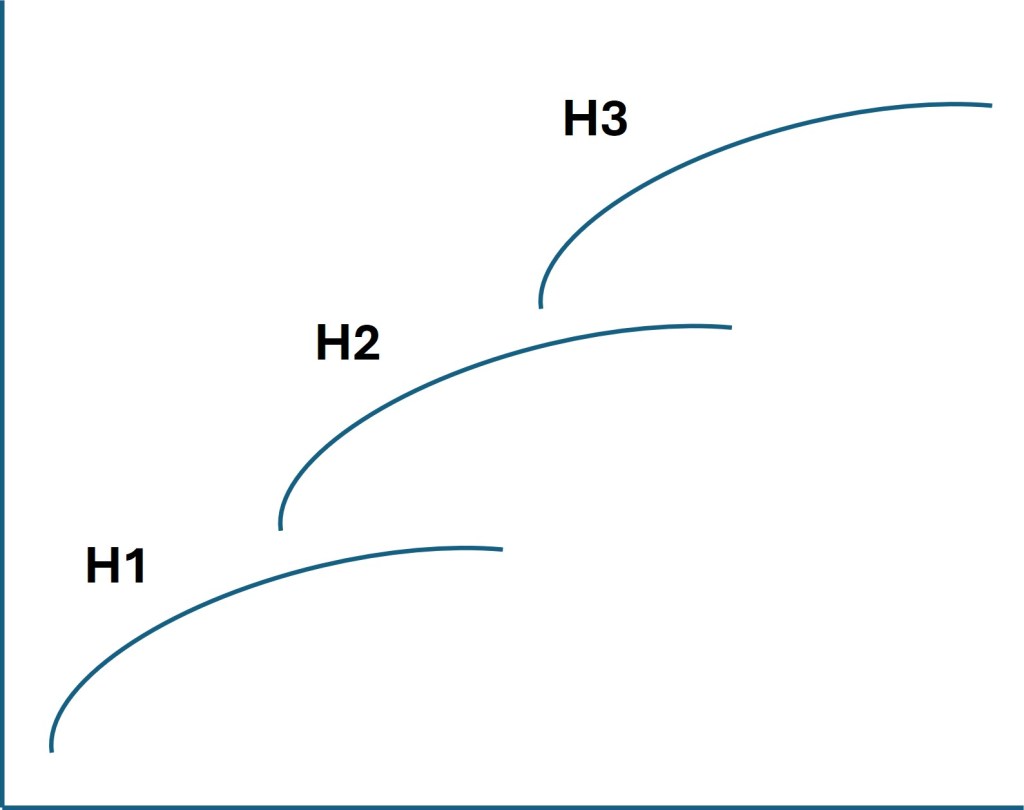
This means that as you work today, you are thinking about today, tomorrow and the future… As we all have experienced, time passes so quickly, so unless you are focused beyond today, you may never make the time to get it done.
 Sean O'Neill's Blog