
Once you have set your Vision, Mission, Values and Strategy, its time to build out your 3-Pillars that flow down from your Strategy and Goals through to every company level Objective and the related Key Results (OKRs). The 3 Pillars are intended to provide a balanced approach to OKR setting and prioritization, as each pillar is equally crucial to ensuring successful performance and outcomes.
And as you focus more internally on the 3 Pillars, you should also dedicate time as a leadership team to determine your Differentiators. These are the unique aspects of what your solution provides that will set you apart from your competitors. I often hear that what a company does is not really different from anyone else… If that is the case then why would a customer ever select you to support them? Based on price? Bottom line, you MUST determine what sets your offering apart as everything you do in Sales/Business Development and Marketing needs to be built on what sets you apart un some unique way from others.

Solution Excellence – Regardless of the type of business you are in, what you provide to customers is some version of a solution to a need or problem. This pillar is focused on how you are committed to making your solution as uniquely differentiated from your competition as possible, and what it takes to set the bar to do that and deliver on it every single year. Also important under this pillar would be how your focus on customers ultimately results in value for them.
Operational Excellence – Every company has a set of customers they must satisfy, and make successful to keep them for the long-term. This pillar is focused on how you are committed to high performance, maximum efficiency, and continuous improvement in how you manage, deliver, and grow your business. When a company is fully committed to achieving excellence operationally, they will have an engine under them that can run and scale in an accelerated way.
Organizational Excellence – Every company should want to be a great place to work. Why? Because you will then have engaged team members who fully support the companies goals and objectives. But a culture that enables being a great place to work has to be created naturally, through trusted and trusting leadership. One of the foundational elements of achieving excellence organizationally is to continuously develop your teams Knowledge, Skills, and Abilities (KSAs) – investment here will provide an ROI many times over.
Pulling this all together, we end up with a framework for your Strategic Plan:
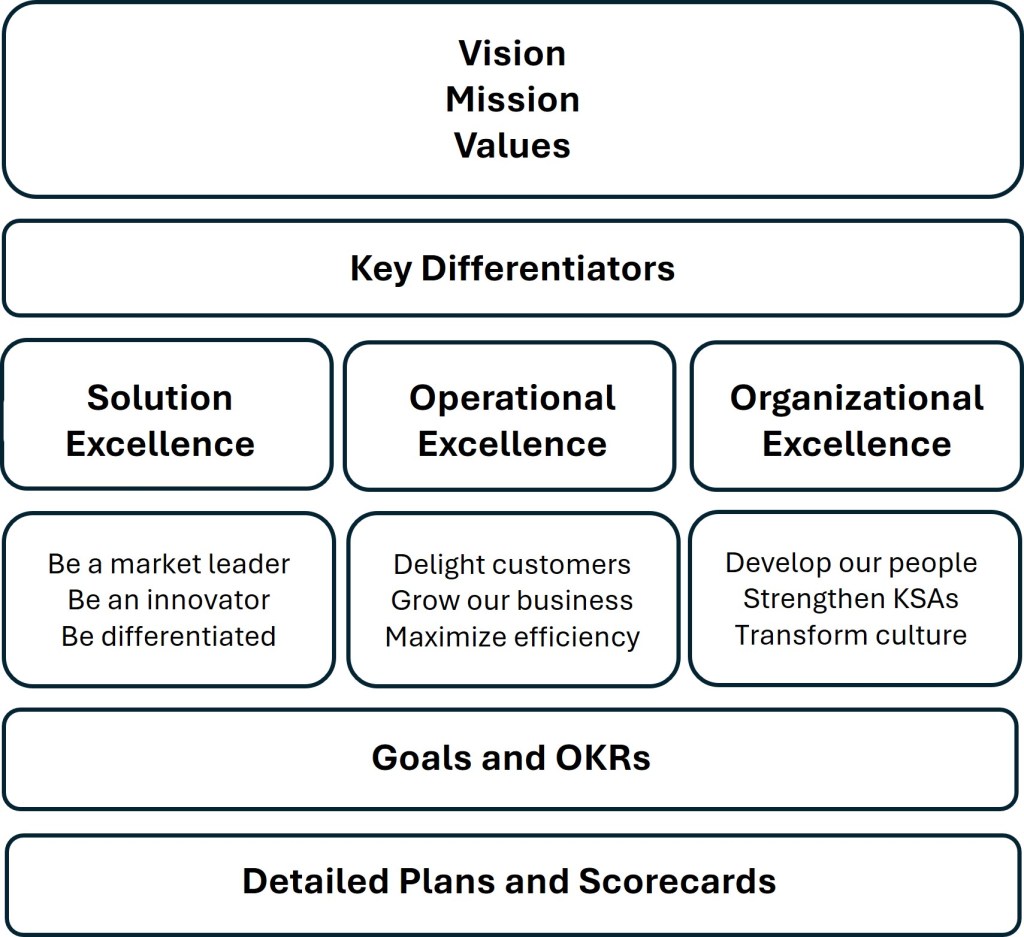
Once you have built your Pillars, it is time to develop your Goals, and OKRs.
Goals should be set that will motivate each member of your team towards achieving them. Your Goals should set the long-term destination of the company and be aligned to the company’s Vision and Mission. And of course, they should be SMART (Specific, Measurable, Achievable, Relevant, and Time-Bound).
Objectives should also be SMART. As you set Objectives, they should be formal actions that must be undertaken to achieve a Goal. In simple terms, you must accomplish one or more Objectives to accomplish one or more Goals.
Key Results are metrics or Key Performance Indicators (KPIs) that measure progress towards the completion of an Objective, and ultimately of a Goal. To capture all the Key Results in one place, you should create one or more Scorecards that feature the target result, and the actual results realized.
Once you have built out your 3 Pillars and set your Goals and OKRs, its time to develop your Operating Model across the 3 Horizons.
 Sean O'Neill's Blog